Photo of Jared Platt

Jared Platt's vcard
Download
Jared's
vcard.

Tag: photography lesson


Shelby and Nick’s Engagement Portraits in Phoenix, Arizona

April 10th, 2011 — 3:09am

Nick and Shelby’s Engagement Portraits in the Phoenix Arizona Desert from Jared Platt on Vimeo.

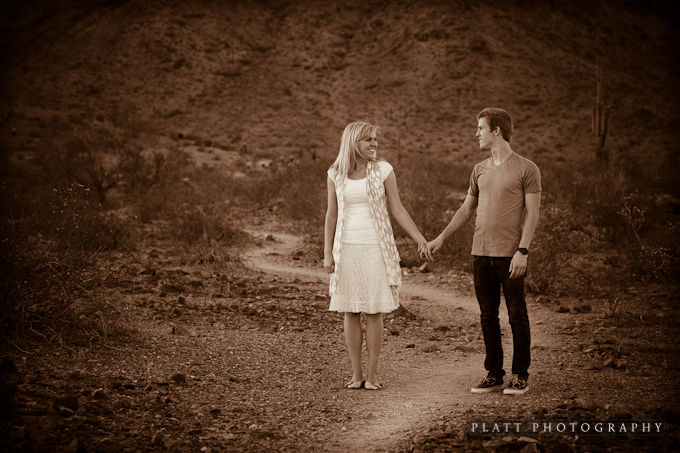
We started this engagement portrait shoot at Shelby’s parents home in Phoenix, Arizona and ended it in the desert as sunset.  Shelby’s parents home is in the shadow of the mountain about two and a half hours before the sun sets, so there is a lot of great open shade around the home, which makes for fantastic images.  The color and texture of the stones is quite nice to work with as well.  And of course, Shelby and Nick are a good looking and cool couple, so it was a pretty nice afternoon.

The night after the engagement shoot, I posted one of the images from the shoot on my Facebook Page.  The shot is below.  Shelby just happen to have a card board cutout of Jacob, from the Twilight Movie series in her trunk.  I remember trying to watch one of those movies on a 14 hour flight home from a wedding in Hong Kong and it was so bad, so poorly acted, that I shut the movie off and did nothing for two hours rather than watch that movie.  It was a lot of fun and the shot makes me laugh, every time I look at it.

We had a lot of laughs while we were making the shot.  And if there is one thing that is extremely important at an engagement portrait session, it is having a lot of good laughs.  It certainly makes my job more entertaining, and the by-product is that the photos look better too.

So, here is the first photo I posted, the night of the engagement shoot.

Engagement Portrait in Phoenix Arizona in the Desert with a cut-out of Jacob from the Twilight Movies

There were so many great shots from the afternoon.  I have posted a few of my very favorite shots below.

Engagement Portrait in Phoenix Arizona against Brick wall

This was one of the earlier shots in the day.  The huge windows behind them make for some fantastic back light and the stair case made for a great angular element to hold the top of the photo together.  For those of you interested in the lighting on this shot, there is a shoot through translucent umbrella above, forward of and to the right of the Nick.  This light is giving the couple some volume by side lighting them, but we are not too dramatic, because it is at a 45 degree angle on them and it is a shoot through umbrella which softens the light a bit because the direction of the light is less defined.  The light was simply a 580EXII Canon Flash attached to a Radio Popper.  My camera is also sporting a 580EX flash with a Radio Popper transmitter and the flash is pounding up into the ceiling to give a little fill light throughout the room.  And then, of course, the window lights are providing shape of the stare case, and a little hair light for the couple.The shutter speed is at 125th of a second and the ISO is at 400.  This allows me to get a good blast from the ambient light outside and the aperture is at 2.8, which gives me that soft look in the background.  I am shooting on a fixed 85mm lens.  The 85mm 1.8 is not a very expensive lens, but it takes a beautiful image.  I love that little lens.

Engagement Portrait in Phoenix Arizona in Home Easy Chair

I love the reflection in the pool and the blue set against the yellow blooms of the desert trees.

Engagement Portrait in Phoenix Arizona by the Pool

Of all the images at the house, this has to be my favorite.  The stone and the tree are fantastic and the tree frames the couple very nicely in the bottom left corner of the photo.  You have to love the color in this one.

Engagement Portrait in Phoenix Arizona against Brick wall under a blooming tree

Engagement Portrait in Phoenix Arizona the Bride

I just love the expressions on this one.  Oh, and the composition.

Engagement Portrait in Phoenix Arizona against Brick wall

Just behind their home, on the side of the mountain is an outcropping of rocks that was quite difficult to photograph.  Once we got them up to the rocks, I had to take position on the top of a wall to get the right angle on the shot, but how can you not love this one.  I was so happy with the image composition and then, Shelby put he elbow up on Nick’s shoulder and that made the photo!  I told her to keep that pose and “never stop!”  I think those were my actual words.  Way to go with this one Shelby.  Way to go.

Engagement Portrait in Phoenix Arizona in the desert mountains

Engagement Portrait in Phoenix Arizona in the Desert

I enjoy the quality of the light after the sun has gone down for about 15 minutes or so.  There really isn’t a better light.  I used to capture this kind of light on film, but I had to use a tripod, I was often shooting a 4×5 camera (those old accordion looking cameras with the dark cloths over the photographer’s head) and the exposures were 30 seconds and of landscapes.  I am so happy with digital cameras today.  6400 ISO?  No problem.  I could enjoy shooting an entire photo shoot AFTER sunset!  It really is the best light ever.

Engagement Portrait in Phoenix Arizona in the Desert

Sweet light.  Sweet kiss.  Sweet shot.

Engagement Portrait in Phoenix Arizona a Final Kiss

Photography by Jared Platt, Platt Photography
Shoot: Engagement Portrait Session
Location: Phoenix, Arizona, South Mountain
Slideshow Music: Mindy Gledhill, courtesy of Triple Scoop Music

Comment » | Engagement Portraits, Lighting, Photographing, Photography, Photography Lessons, Slideshows, Uncategorized

Being Ready for the Moment: A Montelucia Wedding in Scottsdale, Arizona

December 6th, 2010 — 12:08am

Arizona Wedding at the Montelucia in Paradise Valley Candles on Table

This is a quick note about one image I captured last night at Lindsey and Brandon’s wedding last night at the Inter Continental Montelucia in Paradise Valley, Arizona.  It was a beautiful wedding which was designed and styled by Embellish (a fantastic team) with Flowers by Amy’s Floral Design.

BEING READY FOR THE MOMENT

On taking this photograph, I was reminded of the importance of being ready for the shot, which requires an intimate knowledge of photographic principles of light, exposure and of course skill of execution.

This was not a posed shot.  And when photographers today say that, they often mean, “I didn’t tell the bride to stand here and put her finger here and tilt her head just so.”  When I say, it was not a posed shot, I really mean it was not a planned shot.  I was down the hallway taking a snap shot of the bride’s father and a few friends, when her father saw his daughter down the hallway looking at the place card table and remarked upon it.  I spun around and saw this shot.  Had I planned it, I would have asked her to put down the drink in the right hand and then we would have shot a much less natural shot.  But it was this moment that was important.

I left the candid shots I was taking and moved quickly to get close enough for the shot.  As I moved there, I spun the dials on the camera to the correct settings for the best exposure and spun the flash head around into the right direction for a pleasing bounce and set the flash at the correct setting to produce an appropriate amount of fill light.  All of these changes were done while speed walking toward Lindsey.  Once I was in position, I stopped, aimed, focused and shot three frames.  That was it, that was the end of the opportunity.  I got the first two shots off before Lindsay became aware of the camera, but I encouraged her to ignore me (which she did), and I got one more of her looking at something on the table.

It was the first two shots in this moment where she is almost touching the flame of the candle that grab me.  It was late in the evening; she left the party for a moment and was all alone with one of the many beautiful tables, admiring the beauty of the decor and resting from the excitement of the day.  No doubt some happy thought was floating in her head in that half conscious state we all experience when mesmerized by the flicker of candlelight.  And this thought brought a peaceful look to her face (that is not easily fabricated).  That thought is the moment I captured here and that I am now so thrilled to pass on to you.

At the end of such a beautiful day, I am so glad she had an opportunity to step out alone and reflect on how well the event came together and to appreciate the wonderland she created with the help of the professionals at the Montelucia, Embellish and Amy’s Floral Design.  And I am glad to have been there at that moment, and glad for the training and practice that allow me to be ready for that moment because a knowledge of exposure is just second nature.  Don’t misunderstand, it is not about the equipment and the technical stuff, it never is.  It is about the moment.  It’s just that those who know their technical by heart, have more opportunities to capture the moment.

__________

For those of you interested in camera setting, the camera is at the following settings:

-ISO 800 – good for indoor lighting exposure with minimal grain on the Canon 5D Mark II.
-f5.6 – allows me to have a little extra depth of field to get some focus on the entire table, but still wide enough to allow some additional light in.
-1/15 Second Shutter Speed – This is called dragging the shutter.  I needed the candles to glow nice and brightly.  And since the shutter speed controls the ambient light without regard to the added flash, the best way to get the candlelight at 800 ISO at 5.6 was to drag the shutter at a slower speed.  In normal lighting conditions, this would cause camera shake concerns, but it was so dark in the hallway, that the only thing that was going to be exposed by the slow shutter speed was the candles themselves and a little bit of glow on the bride.  So, I was not to concerned about movement on the part of the bride or the camera.  Of course, when I took the shot, I planted myself firmly on the ground and practiced my snipper breathing.  Of course these settings would not work with a moving subject quite so well.
-Then comes the flash.  Bouncing the flash off the right corner of the ceiling with a slight bit of forward flash then filled in the areas of the scene that needed to be seen, but were obscured by the darkness.  The flash also served to freeze the movement of anything darker than the candlelights.  I had the flash on TTL with a slight flash compensation reducing the power output of the flash by 2/3 a stop.  This kept the flash from overpowering the ambiance in the hallway and the general glow on the brides face, but allowed the dress to light up along with brightening up the face enough to soften the contrast that would have been in the shot without the fill of the flash.

3 comments » | Photographing, Photography, Photography Lessons, Uncategorized, Weddings

Framing Photos from Inside a Sunset

August 9th, 2010 — 9:04pm

I looked out the window the other evening and the whole world had a Tang orange glow.  Nothing looked right and as I went outside with my boys to investigate, I walked into another world.  The clouds were thick and full of rain, so very little light came through them, but instead spilled over them from the sunset below.  The dust was so thick that we were not looking at the sunset, we were in the sunset.  It was a magnificent sight.  There was, of course no time to go anywhere other than stay right outside my home and watch this spectacle change as the sun dropped to the unseen horizon.  And when this kind of thing happens, you stay outside with your camera until the sun goes down completely.  I couldn’t have asked for a better evening with my boys, watching such an incredible display of light and clouds.

As I photographed the clouds, I thought of a conversation I had with John Craig from Pittsburgh about photographic composition and the critical nature of the frame.  I asked him, “if you could pass on to your daughter, only one thing about photography, only one quick lesson, what would that be?”  It is an interesting question and one I think everyone should ask themselves.  What would you pass on to the next generation if  you had only one concept to pass along?  Think about it before you answer.  Some will say something like “follow your passion” or some such platitudinous drivel, which has nothing to do with better photography.  What I am asking for is serious conceptual advice on making better photographs, compositional strategies and theories that will, if learned and practices, make any image (no matter the content) into a better photograph.

My answer to my own questions is this: I would teach my child how to see and use the frame well.  There are so many theories and strategies that go into using the frame of the image, which is a lesson for another time, but there is no question in my mind that it is the most important aspect of photographic composition.  Yes, of course there are others, but the frame is where it all starts and ends.  It is the great unifier of photography (we all have four edges to our frame).  And yet there is nothing that damns so many photographers to second rate status because they do not use the frame well (mostly, they don’t pay attention to it).

So I offer the following as a method for training your eye to use the frame wisely:

Alfred Stieglitz made a series of photographs of clouds, which he called “Equivalence“, in which, he was attempting to photograph object, which in and of themselves held no loaded messages, and simply explored controlling random compositions as pure abstraction.  The theory being that without the loaded imagery, one could focus more on communicating the expressions of the inner soul directly to the soul of the viewer.  All a bit too artsy for me, but there was still a brilliance in his selection of clouds as a subject.

The experience of photographing clouds is a fantastic lesson in framing which is the cornerstone of composition.  The organizational structures of the clouds keep changing, morphing into something new every minute, so that there are an infinite number of frames before your camera, with constantly changing elements.  But there are no intellectually loaded symbols to distract the photographer, so the act of including or excluding something is not to avoid a particular statement or to make a point, but rather it is simply to create a stronger composition.

The greatest failure of inexperienced photographers is their inability to emotionally and intellectually distance themselves from the subject matter and watch for composition.  But, with clouds, a photographer has the freedom to practice composition by disregarding the content and dealing only with the composition.

So, with such a perfect opportunity, I took a few moments to practice my framing and enjoy the experience of pure compositional shooting.  Here is my favorite image.

 Platt-Photography-1

And when I say, Tang Orange, I mean it.  This is perfectly accurate color.  What you see here was exactly what we were seeing.  We were literally inside the sunset.

 Weather-2

3 comments » | History of Photography, Landscape, Photographing, Photography, Photography Lessons

Photographing Children without Stress

July 31st, 2010 — 9:50pm

I have the greatest respect for multiple birth parents.  One baby is life altering.  Two must rock your world.

Like parenting twins, photographing them is also exponentially challenging.   Fortunately, I think my photographic style gives me an advantage in the challange.  Because I am interested in real life, I love a photograph of a crying baby as much as I do a smiling baby, and I am not consumed with getting a pre-determined shot that may not come, I am liberated to simply create and enjoy the challenge.

 Infant portraits by Jared Platt

Of course, parents, will generaly stress out about the photoshoot because they have paid for my time and have certain pre-conceved notions about what a baby portrait should look like and what kind of shot they want to get.  But, my advice to every parent, weather they are hiring me, or just trying to photograph their own children, is to simply go with the flow.  Never force the photograph, and let it become what it will.

A twins infant portrait is the perfect laboratory to prove this hypothesis.  In this case, I arrived at the home in the late evening and the mother and father know me and trusted what I was doing, so there wasn’t a lot of stress over the photos.  Of course, this is crucial to the success of the shoot.  If mom is stressed, baby will be stressed.

The first thing I tell parents is that we are going to keep shooting and get lots of great images and that babies are cute, no matter what they are doing, so relax and let’s just have fun, even if the children are crying.  The other thing that I do to maintain the relaxed atmosphere is to plan enough time for the photo shoot.  If the baby needs to eat, then we need to take a little break and I can take photos of the babies toys or talk with dad.  Rushing the parents or the baby, will only end in failure.

With plenty of time and a relaxed mom and dad, the stage is set for a successful photo-shoot, but the most important element is the understanding that I am there to photograph children as they really are, smiling or crying, and that gives me the freedom to concentrate on the photographs that I am making.

 Infant portraits by Jared Platt

Some people are not comfortable with this concept and want to control the final outcome, and there are some very good photo factories that are perfect for that.  A parent can go to the mall and choose from the catalog of props and sets and have a photograph of their child in a chefs hat in a cooking pot and they will walk out with the print they saw in the catalog, with their child in the pot rather than the model baby.  It is something akin to keeping buying a frame at the store and pasting your kids faces over the happy people in the stock photo that came with the frame.  It is very predictable and the people who work at these photo factories know the menu and they know the recipe for this shot and that.  It is predicable and safe and there is nothing wrong with that.  But the parents who come to me for portraits are interested in something special and unique to immortalize their child.  They want something real, something that means more than just a cute portrait.

 Infant portraits by Jared Platt

Coming into the home, allows the child to be photographed in a unique environment that is filled with memories and spirit and as I use this natural surrounding, the child is placed at ease and more importantly, nothing is a prop, because everything has meaning.  And by discarding those pre-conceved shots and just taking things as they come, we are all open to letting things happen and enjoying the experience.  And we still end up with some of those cute traditional photographs, but without the stress.  However, I will always maintain that the less planned images are always the best.

 Infant portraits by Jared Platt

It certainly is not a predictable way to photograph a child, but children aren’t predictable anyway and in the end, no one can doubt the outcome.  The images are full of emotion, humor and joy and are extraordinary portraits that will be cherished forever.

Of course, you can judge the results for yourself.

 Infant portraits by Jared Platt

 Infant portraits by Jared Platt

 Infant portraits by Jared Platt

1 comment » | Childrens Portraits, How-To-Articles, Infant Portraits, Photo Shoots, Photographing, Photography, Slideshows

A Dust Storm Rising: Takes Me Back Home

April 22nd, 2010 — 5:00pm

Living in the desert is a unique experience.  Forget about the 120 degree summer days and the horribly unfriendly plant life.  To me, the weather is quite fascinating.  I love the monsoon rainstorms and the lightning is fantastic.  Other places in the world have their own challenging weather situations, many much more dangerous.  There are tornadoes, hurricanes, earthquakes, blizzards, etc…  and none of these options are very appealing to me, which is why I prefer my native state of Arizona.  But we do have our own unique weather effect: the dust storm.

I was traveling back from a job in Tucson and took a back road route home (rather than the freeway).  I enjoy doing this because everything goes by so quickly on the freeway and there is no inclination to stop and look at anything (and of course, it would be illegal to do so).  So the back roads are much more enjoyable as road trips go.  On my way home, I saw an approaching dust storm and immediately pulled off the road and pulled out the camera and went hiking.  The Arizona dust storm has a beautiful effect on our world.  It creates a ghost of anything in the distance if not, it completely obscures it.  Like a blizzard, it creates a thin sketch of the landscape with little to no contrast.  I am generally haunted by vacancy in an image.  I am not sure why, but of all the photographs I would select to hang in my home, it is those filled with quiet and solitude that appeal most to me.  That doesn’t mean that I choose to photograph this way all the time, but it has the deepest emotional affect on my soul.  I think it is because that is who I am at my core.
 Dust Storm Rising: Coolidge, AZ

If you are drawn to a particular style of photography, or art, and looking at that work brings you home, you can be sure that that attraction says a lot about you as a person.  In fact, weather you like a photograph or don’t, says less about the photographer or the photograph and more about you as a person.  Which is why, I think, that I get along so well with my clients.  They have selected me as their photographer based on their emotional and intellectual response to my work.  Which means that they, in some way, deep down at some root level, are like me.  We agree on what gives us peace and brings us home.

When I got home and started working with this image, I asked my wife about this image.  ”Am I off base, or is this image extremely haunting and beautiful?”

“I can see what you are attracted to in the image,” she replied, “but it’s not all that great!”

No, I wasn’t devastated by her comment.  I just decided she was wrong.  It is great, but perhaps only to me and people like me.  Remember, her reaction to the photograph says more about her, than it does about the photo.  In contrast, I think my friend Isaac Bailey would like it.  But I think we share a common love for solitude (or perhaps it is a sullen longing for sleep).  My wife grew up in the city with all of its distractions and noise, I grew up on the prairies of Northern Arizona where the only noise is the constant wind.  So, my wife’s take on this photo was an instructive reminder to me.  My wife is a good judge of a photograph, which tells me that this image is different, my attraction to it isn’t just about some other brilliantly employed compositional strategy, I didn’t make this picture to sell something or even to make a statement.  I made it because something inside me wanted to go home for a little while and relax there in the shadow of the Zuni Mountains and look over the endless flat land, smell the dust, swap stories with my brothers and wait until dark for a ride back into town.  This was a free ticket back to Bitter Springs after the long climb through The Gap to witness the brilliant view from the tops of the Vermilion Cliffs.  Sometimes photography isn’t about the subject in front of us at all.  The subject is just a catalyst for memory, a sort of psychiatrist’s couch for introspection and self discovery.  And sometimes, a photography session reminds you of who you are.

These introspective moments almost never happen while the camera is in your hands.  They come in the quiet times in the darkroom, or the Lightroom as you study the results.  And while my mantra is always about efficiency in post production. When I feel that prompting, I do my best to slow down, and examine my work closely without distractions or deadlines and find out what it is, I have been trying to say to myself.

A few more images from the series that I think you might enjoy.

 Dust Storm Rising: Coolidge, AZ

 Dust Storm Rising: Coolidge, AZ

 Dust Storm Rising: Coolidge, AZ
 Dust Storm Rising: Coolidge, AZ

Tech Talk: All of the images in this post were completely processed in Lightroom.  They were never opened in Photoshop.  Tones, grain and vignettes were all added in Lightroom without the use of any additional plugins etc.  Below is a video about creating custom vignettes in Lightroom like those you see above.  This video is also on iTunes and on the Pictage Blog.  Check out more of my podcasts at iTunes and more blog posts at Pictage Blog.

Creating Custom Vignettes in Adobe Lightroom 2.6 from Jared Platt on Vimeo.

Comment » | Adobe Lightroom, How-To-Articles, Landscape, Notes on Photography, Personal Notes, Photography, Photography Lessons, Stories, Travel Log

Back to top